Thứ Bảy, 24 tháng 9, 2011

Vietnam War Museum


Vietnam War


Although this blog prefers to focus on the present of Vietnam, its people, its places and all that it offers the visitor... we also think that "Those who forget history are doomed to repeat it", that's why we decided to tell you about the Vietnam War Museum.


Guerra de Vietnam, tanque
Vietnam Military History Museum: Vietnam War Tank


Vietnam War Museums


Actually there are several War Museums spread in different cities of Vietnam. We recommend you to visit Vietnam Military History Museum in Hanoi and Vietnam War Remnants Museum in Ho Chi Minh City.


Vietnam Military History Museum (Hanoi)


Vietnam Military History Museum in Hanoi is located in one of the corners of Hanoi Ciudatel, specifically on 28 Dien Bien Phu. The entrance fee is 1� and they are open from Monday to Sunday from 9am to 5pm.

The main gate is guarded by two huge cannons, a few meters away, a coffee shop of the group Highlands Coffee and behind it, the flag tower of Hanoi Cidatel.


Guerra de Vietnam, helicoptero
Vietnam War Helicopter - Vietnam Military History Museum


From our point of view, the most striking part of the visit is the backyard, where they exhibit tanks, ground vehicles, helicopters and planes used during the Vietnam War

As a piece of advice we will say the backyard where the airplanes and other war machinery are, can be seen from the street Nguy?n Tri Phuong, without paying the admission fee.


Avi�n Americano usado en la Guerra de Vietnam - Museo de la guerra
American fight plane used during Vietnam War - War Museum


Guerra de Vietnam, bater�a anti-aerea
Vietnam War: anti-aircraft battery


Website of Vietnam Military History Museum in Hanoi


This is the website of the museum (available in English and Vietnamese): http://www.btlsqsvn.org.vn


Vietnam War Remnants Museum (Ho Chi Minh City)


Our next recommendation is Vietnam War Remnants Museum in Ho Chi Minh City. It is located in front of the Reunification Palace of Saigon, on the street 28 V� Van T?n.


Vietnam War Remnants Museum - Ho Chi Minh City


This museum in particular, is very focused on the atrocities and human rights violations committed during the War of Vietnam, especially the effects of Agent Orange in the population (called by the Vietnamese people the orange poison). The photographs displayed in this museum may offend your sensibility and we do not recommend visiting the museum with children.


Timetable and ticket price of Vietnam War Remnants Museum in Ho Chi Minh City
The ticket costs 10.000VND around half dollar (*see Vietnam Currency). The Museum is open daily from 8am to 11:45am and from 1:30pm to 16:45pm.


Useful links for your visit to Vietnam War Remnants Museum in Ho Chi Minh City

Thứ Sáu, 23 tháng 9, 2011

Vietnamese dress Ao Dai


Vietnamese Dress: Ao Dai (�o D�i)

�o D�i, the Vietnamese traditional dress

Ao Dai is a traditional dress in Vietnam. It's also a symbol of Vietnam. Whenever you hear about Vietnam, definitely you will hear about Ao Dai (�o D�i in vietnamese). Ao dai nowadays is very popular with different designs and colors. Ao dai is written like this ?? in ch? N�m - the old kind of writing of Vietnam.


History of Ao Dai (�o D�i)

In fact, nobody knows the original history of Ao Dai (�o D�i). There was no evidence which says about where and when the Ao Dai appeared. At the beginning, we don't know what was the real design of Ao Dai. Researchers show that the Ao Dai (�o D�i) stared to be wore thousand years ago.


Girl in Vietnam dress Ao DaiThe King Nguy?n Ph�c Kho�t was considered as a person who discovered and made the �o d�i have its form. Until 16th century, Vietnam was still affected by Chinese culture including clothes. To keep Vietnamese's culture, Nguy?n Ph�c Kho�t said in one of his "law" about the design of Vietnamese's clothes which was similar to Ao Dai nowadays. Because of that reason, Nguy?n Ph�c Kho�i could be the one who started the history of Ao Dai (�o D�i).


Vietnamese men and women wore Ao Dai until 1947 when Vietnam got the independence and the government had the campaign: di?t gi?c d�i, gi?c d?t (fight against poverty and illiteracy). On Match 20, 1947, Ho Chi Minh (H? Ch� Minh) wrote "�?i S?ng M?i" (New Life) and told people should stop wearing Ao Dai because it took more material than normal clothes and it was not convenient for people to move, or to work. If we wore normal clothes, we had saved 200 million d?ng/ year. Most people joined this campaign and Ao Dai wasn't wore in the North for a long time.


Le Mur

Le Mur was the name of Ao Dai (�o D�i), translation from Vietnamese into French. Le Mur was a new style of Ao Dai, which was created by an artist named C�t Tu?ng in 1930. There were many changes in this style and to be "fashionable" Le Mur Ao Dai had to be wore with white pants, high heels, umbrella and purse. People didn't accept this change.


Up to 1934, L� Ph?, another artist made the new design for Ao Dai (�o D�i) from Le Mur and traditional Ao Dai (which had 4 or 5 pieces). From here, Ao Dai was with 2 pieces, tightened the body and closed at the neck. This was the perfect design that all the women at that time liked it and it became the only basic design for Ao Dai.


Miniraglan

Miniraglan was the kind of Ao Dai (�o D�i) for female students. With this design, the length of Ao Dai was just at the knees and the pants were loser. The students would feel more comfortable with this design and the Ao Dai also made the students become more lovely.


Girl students with Aodai, the Vietnamese dress


At the end of the year 1958, Mrs. Tr?n L? Xu�n created another design for the �o d�i which the neck was around neck (c? thuy?n). People usually called it "�o d�i Tr?n L? Xu�n or �o d�i Mrs. Nhu". Some critics said this Ao Dai (�o D�i) was not suitable for tradition and custom in Vietnam. However, it was popular and is still in use until now. Mrs. Tr?n L? Xu�n died at 2AM, April 24, 2011 in Rome, Italy when she was 87 years old.


Ao Dai (�o D�i) A symbol of Vietnam:

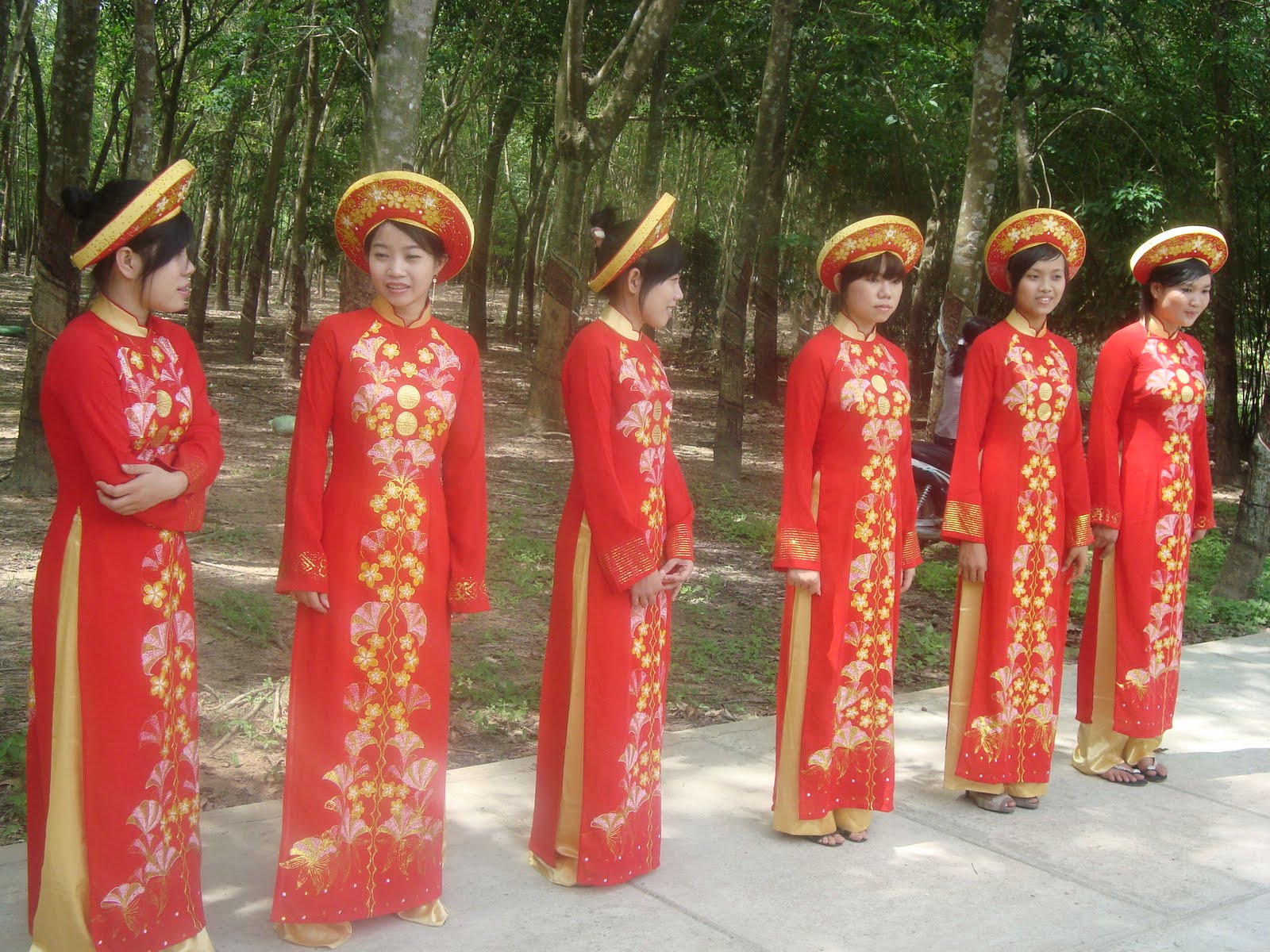
Differently from kimono or hanbok, Ao Dai (�o D�i) is wore in many occasions, not only traditional cases. We use it at work or at school as uniform. We wear it to go out or to be in fashion shows. Especially in wedding, we have a kind of hat to go with it.


Weddding yellow Ao with hat
Weddding yellow Ao with hat. Yellow Vietnam dress


Ao Dai (�o D�i) is a unique design which both respectful and charming. It reflects the body of the person who wears it. The cut of 2 pieces is at the waist, which makes the women easy to move. The material is silk, so the body is inside the soft material which makes women become more feminine.


As mentioned before, Ao Dai (�o D�i) reflects the body of the one who wears it, so each Ao Dai is just suitable for only one person. We can't make one Ao Dai for many people. It can be, but it will not be beautiful. When making an Ao Dai (�o D�i), the tailor will take the measurement carefully. One wrong measurement will destroy the beauty of Ao Dai.


Ao Dai nowadays

With the develop of the country and the develop of the fashion, Ao Dai (�o D�i) is also developed. Ao Dai is more fashionable and more popular.


Ao Dai in Vietnamese school. Students with Aodai


Beautiful girl wearing Vietnamese traditional dress Ao Dai
Beautiful girl wearing Vietnamese traditional dress Ao Dai. District 7 of Ho Chi Minh City (Saigon), Vietnam


At the same time, tourists who want to make Ao Dai (�o D�i) when they are in Vietnam, they can come to many shops in Ho Chi Minh city, Hue (Hu?), Hoi An (H?i An) and Hanoi (H� N?i). Those shops can make Ao Dai very quickly, only 1 day.


More about Vietnamese dress Ao Dai (�o D�i)

Vietnamese dress Ao Dai


Vietnamese Dress: Ao Dai (�o D�i)

�o D�i, the Vietnamese traditional dress

Ao Dai is a traditional dress in Vietnam. It's also a symbol of Vietnam. Whenever you hear about Vietnam, definitely you will hear about Ao Dai (�o D�i in vietnamese). Ao dai nowadays is very popular with different designs and colors. Ao dai is written like this ?? in ch? N�m - the old kind of writing of Vietnam.


History of Ao Dai (�o D�i)

In fact, nobody knows the original history of Ao Dai (�o D�i). There was no evidence which says about where and when the Ao Dai appeared. At the beginning, we don't know what was the real design of Ao Dai. Researchers show that the Ao Dai (�o D�i) stared to be wore thousand years ago.


Girl in Vietnam dress Ao DaiThe King Nguy?n Ph�c Kho�t was considered as a person who discovered and made the �o d�i have its form. Until 16th century, Vietnam was still affected by Chinese culture including clothes. To keep Vietnamese's culture, Nguy?n Ph�c Kho�t said in one of his "law" about the design of Vietnamese's clothes which was similar to Ao Dai nowadays. Because of that reason, Nguy?n Ph�c Kho�i could be the one who started the history of Ao Dai (�o D�i).


Vietnamese men and women wore Ao Dai until 1947 when Vietnam got the independence and the government had the campaign: di?t gi?c d�i, gi?c d?t (fight against poverty and illiteracy). On Match 20, 1947, Ho Chi Minh (H? Ch� Minh) wrote "�?i S?ng M?i" (New Life) and told people should stop wearing Ao Dai because it took more material than normal clothes and it was not convenient for people to move, or to work. If we wore normal clothes, we had saved 200 million d?ng/ year. Most people joined this campaign and Ao Dai wasn't wore in the North for a long time.


Le Mur

Le Mur was the name of Ao Dai (�o D�i), translation from Vietnamese into French. Le Mur was a new style of Ao Dai, which was created by an artist named C�t Tu?ng in 1930. There were many changes in this style and to be "fashionable" Le Mur Ao Dai had to be wore with white pants, high heels, umbrella and purse. People didn't accept this change.


Up to 1934, L� Ph?, another artist made the new design for Ao Dai (�o D�i) from Le Mur and traditional Ao Dai (which had 4 or 5 pieces). From here, Ao Dai was with 2 pieces, tightened the body and closed at the neck. This was the perfect design that all the women at that time liked it and it became the only basic design for Ao Dai.


Miniraglan

Miniraglan was the kind of Ao Dai (�o D�i) for female students. With this design, the length of Ao Dai was just at the knees and the pants were loser. The students would feel more comfortable with this design and the Ao Dai also made the students become more lovely.


Girl students with Aodai, the Vietnamese dress


At the end of the year 1958, Mrs. Tr?n L? Xu�n created another design for the �o d�i which the neck was around neck (c? thuy?n). People usually called it "�o d�i Tr?n L? Xu�n or �o d�i Mrs. Nhu". Some critics said this Ao Dai (�o D�i) was not suitable for tradition and custom in Vietnam. However, it was popular and is still in use until now. Mrs. Tr?n L? Xu�n died at 2AM, April 24, 2011 in Rome, Italy when she was 87 years old.


Ao Dai (�o D�i) A symbol of Vietnam:

Differently from kimono or hanbok, Ao Dai (�o D�i) is wore in many occasions, not only traditional cases. We use it at work or at school as uniform. We wear it to go out or to be in fashion shows. Especially in wedding, we have a kind of hat to go with it.


Weddding yellow Ao with hat
Weddding yellow Ao with hat. Yellow Vietnam dress


Ao Dai (�o D�i) is a unique design which both respectful and charming. It reflects the body of the person who wears it. The cut of 2 pieces is at the waist, which makes the women easy to move. The material is silk, so the body is inside the soft material which makes women become more feminine.


As mentioned before, Ao Dai (�o D�i) reflects the body of the one who wears it, so each Ao Dai is just suitable for only one person. We can't make one Ao Dai for many people. It can be, but it will not be beautiful. When making an Ao Dai (�o D�i), the tailor will take the measurement carefully. One wrong measurement will destroy the beauty of Ao Dai.


Ao Dai nowadays

With the develop of the country and the develop of the fashion, Ao Dai (�o D�i) is also developed. Ao Dai is more fashionable and more popular.


Ao Dai in Vietnamese school. Students with Aodai


Beautiful girl wearing Vietnamese traditional dress Ao Dai
Beautiful girl wearing Vietnamese traditional dress Ao Dai. District 7 of Ho Chi Minh City (Saigon), Vietnam


At the same time, tourists who want to make Ao Dai (�o D�i) when they are in Vietnam, they can come to many shops in Ho Chi Minh city, Hue (Hu?), Hoi An (H?i An) and Hanoi (H� N?i). Those shops can make Ao Dai very quickly, only 1 day.


More about Vietnamese dress Ao Dai (�o D�i)

Pictures Hanoi - Vietnam


Pictures of Hanoi (Vietnam)

Pictures of Hanoi: the capital of Vietnam

Pictures of a street restaurant in Hanoi (Vietnam)

Collection of pictures of Hanoi, Vietnam. These are some pictures of a street restaurant in Hanoi, Vietnam, where you can taste exotic dishes such as snake, eel, turtle. The restaurant is very close to the central lake of Hanoi and few meters away from the cathedral. This restaurant is frequented by Vietnamese, on the other side of the street, there are lots of fast food restaurants, pizzerias, etc. Funny how the street restaurant was crowed and tourist restaurants (more oriented to foreign customers / tourists), were mostly empty.


Street restaurant Hanoi Vietnam
Street restaurant in Hanoi, Vietnam.


Eating snake with tofu in a street restaurant of Hanoi (Vietnam)


Hanoi - city pictures

Photos of a building in Hanoi, Vietnam. Sightseeing in Vietnam, I found this building, situated in an outlying district of the capital, would be the equivalent of a subsidized housing in Spain. The apartments are old, its quality is quite poor. These buildings are for members of the Communist Party of Vietnam, officers and people related to the party


Outskirt building in Hanoi Vietnam
Outskirt building in Hanoi, Vietnam.


Photos of the railroad tracks going through the center of Hanoi. The city is huge, the tracks have found their place among the narrow streets of the old city of Hanoi.


Railroad tracks. Hanoi Vietnam
Railroad tracks crossing Hanoi (Vietnam)


One night walking around Hanoi, when the sun set, the city of Hanoi turns into an entirely different place.


Night in Hanoi (Vietnam)
Night time in Hanoi, the capital of Vietnam.


Photos of Ho Chi Minh Mausoleum - Ho Chi Minh tomb

Some pictures of Ho Chi Minh Mausoleum in Hanoi (Vietnam). Where the remains of the vietnamese leader are permanently guarded by 2 guards, that perform a changing of the guard every few hours. A white line, about 15 meters away from the mausoleum, denotes the limit of the tourist zone. Visitors are not allowed to cross the line.


Ho Chi Minh mausoleum
Pictures of Ho Chi Minh Mausoleum


Ho Chi Minh mausoleum in Hanoi Vietnam
Side view of Ho Chi Minh mausoleum


Ho Chi Minh mausoleum is located in a huge esplanade. Also, there is a beautiful park (the citizens of Hanoi take great care of it). In the middle of the park, to the top of the mast, waves the vietnamese flag. The flag dimensions are close to the spanish flag in the Plaza de Colon (Madrid, Spain).


Ho Chi Minh mausoleum park


Vietnamese flag at Ho Chi Minh mausoleum
Vietnamese flag waving at Ho Chi Minh mausoleum


Pictures of the Presidential palace of Hanoi (Vietnam)

The presidential palace is located a few meters from Ho Chi Minh mausoleum, opposite the house where Ho Chi Minh himself lived. The Vietnamese leader Ho Chi Minh, built a humble home made of wood, as Ho Chi Minh didn't want to live in a palace, taking into account the situation of the country and in solidarity with the vietnamese people. The house, which can be visited, is located on the shore of a small artificial lake where Ho Chi Minh used to feed the fishes and meditate. To attract the attention of the fishes, Ho Chi Minh usually claps his palms. The fishes are get used to that sound and thousands of tourists and visitors, clap their hands and throw breadcrumbs into the water to feed the fishes, fishes eat in a few seconds all the food.


Presidential palace - Hanoi - Vietnam
Picture of the Presidential Palace, next to Ho Chi Minh Mausoleum (Hanoi, Vietnam)


Presidential palace view from Ho Chi Minh house - Hanoi (Vietnam)
Picture of the Presidential Palace taken from Ho Chi Minh's house


Ho Chi Minh wooden house (Hanoi)
Ho Chi Minh wooden house (Hanoi, Vietnam)


Fishes in the lake near Ho Chi Minh wooden house (Hanoi)
Photography of the fishes of the lake next to Ho Chi Minh house. Hanoi (Vietnam)


Hanoi, Vietnam. Pagoda pictures

The most famous pagoda all over Vietnam is the one pillar pagoda or one column pagoda, next to the mausoleum of Ho Chi Minh. But outside the city, next to the river, there is a quiet pagoda. The pagoda has 7 floors, representing 7 states to reach as a Buddhist.


Vietnamese pagoda outside hanoi
Pagoda in Hanoi, Vietnam


Pagoda next to Hanoi river (Vietnam)


Pagoda near river. Hanoi (Vietnam)
Pagoda outside Hanoi


One pillar pagoda. Hanoi, Vietnam


Photos of motorcycles in Hanoi, Vietnam

Of course, we can't miss the chance to take some pictures of motorbikes running through the streets of Hanoi, the capital of Vietnam. Hanoi is the political and economic capital of the country. Although the weather in Hanoi is cooler than the weather in Saigon, on the streets of Hanoi you can see many cars. However hundred of thousands of motorcycles are on the streets.


Motorcycle in Hanoi Vietnam
Motorcycle in Hanoi, Vietnam


Hanoi traffic. Rush hour in Vietnam


More pictures and articles related to Hanoi